A 2026 Formula 1 strategy wall for pace, tire degradation, deployment, race control, and scenario comparison.
Orya One RaceSim is built around a Grand Prix decision workflow: choose a 2026 Formula 1 round, review circuit behavior, tune race-control assumptions, compare two scenarios when needed, and inspect calibrated probability-based outcomes from one strategy wall.
Built around a Grand Prix weekend
The current UI now spans the branded hero, the strategy wall itself, and the simulation output board used to read race evolution and decision deltas.
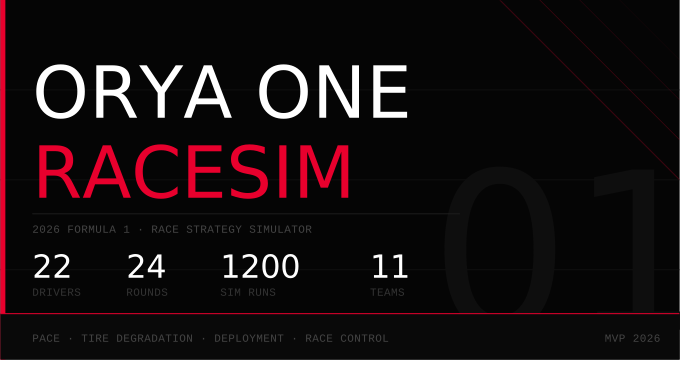
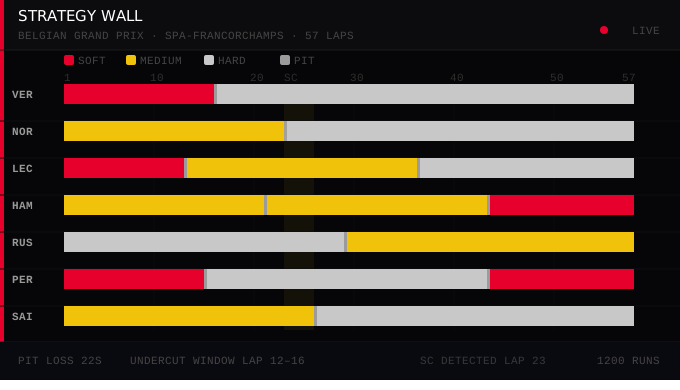
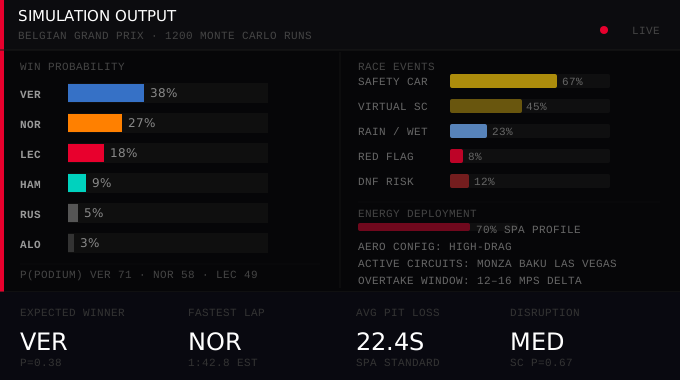
Real 2026 Formula 1 season frame
The app now uses the 2026 Formula 1 teams, drivers, Grand Prix calendar, and Sprint weekends as the base catalog.
Hybrid race model
A compact PyTorch pace prior is combined with explicit race logic for qualifying weight, tire wear, pit loss, and 2026 deployment pressure.
Race control and Monte Carlo
Weather swings, VSCs, safety cars, red flags, incidents, and DNFs are sampled repeatedly so the result stays probabilistic instead of fixed.
Trust and calibration layer
Each scenario now carries confidence, historical support, grounding, and volatility signals so the product is explicit about what is calibrated and what is estimated.
Made to feel like race operations software
The UI is meant to scan like a strategy wall, not a generic analytics dashboard.
Circuit profile, race-control tuning, Compare Mode, trust signaling, and driver-level outputs sit in one workspace. The intent is to make the tradeoffs readable while keeping the flow dense enough to feel useful.
The app still uses modeled pace priors rather than live telemetry, but the season structure, historical support layer, and trust messaging now make it clearer where the simulator is grounded and where it is exploratory.
Set up for deeper realism later
The current architecture keeps the UI, API, and simulator modular enough for future qualifying, calibration, and historical-data work.
Pace is learned, race mechanics stay explicit, and uncertainty is sampled. That boundary is deliberate and shows up throughout the product.